

Premium custom printed boxes — designed, printed, and built in the USA

A Stronger Folding Carton for Heavier Products
Auto lock bottom boxes, also known as crash-lock bottoms, are a type of custom printed folding carton with a pre-glued bottom that locks into place when the carton is opened.
These tuck top cartons, also known as auto bottom boxes, are designed for heavier products that need more support than a standard tuck end box provides.
Pop-Open Setup
Just squeeze the corners and the box squares up with a satisfying click—no bottom tuck to fold or lock.
The glued bottom prevents products from breaking through the bottom, adds rigidity, and gives the carton a solid, substantial feel—exactly what you want in retail packaging for heavier products.
When Should You Consider Auto Bottom Boxes?
Auto bottom boxes are a good choice if you have:
Products weighing around ¾ lb or more
Glass bottles or jars
Breakable retail products
Larger products with wider footprints
Concerns about products pushing through the floor of the box
A Simple Rule of Thumb
Think of an auto lock bottom box as a more muscular version of a tuck end box. The glued bottom creates a more rigid structure and better distributes the product weight across the bottom of the box.
They're especially useful for bottles, jars, breakable products, and other items that benefit from extra support.
If you're concerned that your product could push through the bottom of a standard tuck end box, an auto bottom box is probably the better choice.
Use an Auto Lock Bottom Box When Weight Is an Issue
Get a Quote in 3 Simple Steps
1.
Choose Your Box Style
2.
Enter Your Dimensions
3.
Get Instant Quote

Style of box
style bullets
•
Style
Size:
Length
Width
Depth
Height
Options:
UV
Hang Tab
Window
Volume
value
value
value
value
value
value
value
value
18pt total costs
value
value
value
value
value
value
value
value
18pt cost/box
value
value
value
value
value
value
value
value
24pt total costs
value
value
value
value
value
value
value
value
24pt cost/box
value
value
value
value
value
value
value
value
How Does Box Pricing Work?
Help →
Paper Thickness
Print Finishes
Measure
Reading a Ruler
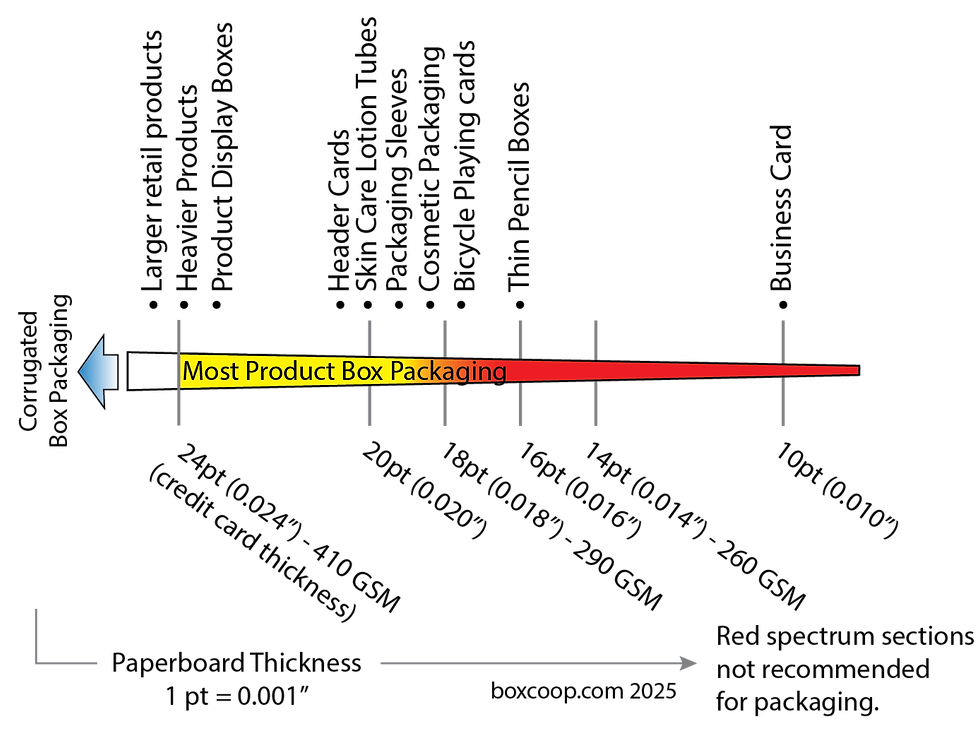
Paperboard Thickness Chart
.png)
What's a Good Paper Thickness for My Box?
-
16pt (0.016″ ≈ slightly thicker than a business card)
-
Best for very small product boxes.
-
Rule of thumb: footprint (floor of the box) of about 1″ × 1″ or smaller.
-
-
18pt (0.018″ ≈ just under credit-card thickness)
-
Strong enough for most cosmetics, food, and shelf packaging.
-
Cost-effective and versatile — the “everyday” choice for custom boxes.
-
Rule of thumb: footprint of about 2.75″ × 2.75″ or smaller.
-
-
24pt (0.024″ ≈ credit-card thickness)
-
Stiffer and more rigid, with a premium feel in hand.
-
Ideal for larger, heavier, or higher-end products where strength and presentation matter.
-
Rule of thumb: footprint of about 3″ × 3″ or larger.
-
Cardstock.... or Paperboard?
The paper behind your packaging matters
You may have seen box specs like “18pt cardstock” online — but not all 18pt paper is created equal.
• Cardstock: A thick paper used for crafts, postcards, and invitations. It’s cheaper and works for lighter packaging — but it lacks the stiffness and durability needed for most product boxes.
• Paperboard: A stiffer material engineered specifically for packaging. It folds cleanly, glues reliably, and holds its shape to protect your product — and your brand — on the shelf.
The key is knowing what you’re buying. In retail, your product box is what closes the sale — so it needs to perform and look its best. That’s why we use a quality paperboard — so your packaging doesn’t just hold together, it helps sell what’s inside.
Curious What a Bit Stronger Box Costs?
Get a quick quote below — all you need is your dimensions.
And if you’re not sure where to measure, we’ll walk you through it.
Have Questions?
Drop us a line - We're Here to Help. We'll Get Back to You Right Away.
But packaging projects are rarely that simple. If you're launching multiple products,
We can often get you better costs.
Want a quick answer? Include your phone number and we'll give you a call. Prefer to talk now? Reach us at 1.800.555.1778.
Let's See What We Can Do →
We're here to help you sell your product. Let's talk about your packaging.
From Product Box to Retail Display
Making Your Auto Lock Bottom Work Harder for You.
An auto lock bottom can do double duty. It starts as a product box, then converts into a retail display when it reaches the store — a convenient, low-cost way to put your products in front of shoppers.
The closing lid can be designed to fold back into a pop-up header, providing extra space for branding and advertising above the products. Front and side panels can also be perforated to tear away, exposing the products and converting the carton into a shelf or counter display.
Adding optional grid-style paper inserts create individual cells that keep products neatly ordered.

Is There a Better Choice for Your Product?
.png)

.png)

.png)


This page is dedicated to auto lock bottom boxes. But they're just one of many packaging styles available.
The film strip above gives you a peek at a few of the folding carton styles you'll find on our Custom Product Boxes page.
Custom Options
Auto lock bottom boxes can be customized with different tuck top closures, security features, display options, and inside inserts.
Straight or reverse tuck top lids
Friction tuck, slit lock, or postal lock closures
Hang tabs for retail display
Half-moon thumb tabs for easier opening
Inside partitions or custom inserts for multi-item packaging
Explore folding carton closure styles and custom insert options →
Frequently Asked Questions
How much weight can an auto lock bottom box hold?
Auto lock bottom boxes can hold a brick if they have to. It depends on how evenly the product’s weight is distributed inside the box. Because the bottom is glued closed, there’s little risk of it being pushed open by the product’s weight, which can happen with many other custom product boxes.
Can you customize auto lock bottom boxes?
Yes. Auto lock bottom boxes are part of the folding carton family, so many of the same options available to tuck top style cartons also apply. Features like different tuck closures, hang tabs, thumb tabs, and inside inserts can all be incorporated depending on the needs of the product and how it will be displayed.
Are auto bottom boxes and crash lock bottom boxes the same?
No. They look similar, but they’re built differently. Auto bottom boxes use glued panels to form the base, while crash lock bottom boxes rely on interlocking bottom panels that “crash” into place—hence the name crash lock. In general, pre-glued auto bottom boxes are a bit stronger.