WE BRING YOUR DESIGN TO LIFE. GET A QUOTE TODAY! 800-555-1778

Custom Tuck End Boxes
The Workhorse of Custom Packaging
The go-to box style for everyday retail packaging
Tuck End Boxes
The Retail Product Packaging Workhorse
Product Packaging That Balances Cost and Presentation
Tuck end boxes are one of the most common folding carton styles used for product packaging—and for good reason. Their simple design makes them cost-effective, easy to assemble, and well suited for a broad range of everyday products.
Tuck boxes are also easy to customize with hang tabs, windows, inside partitions, and other packaging options to suit specific product needs.
Getting Your Message Across
If your product sells at retail, messaging matters—and this is where tuck end packaging really shines. With large printable panels, custom tuck boxes give you plenty of room for branding, product information, and messaging that helps products stand out while speaking to your audience.
That balance of efficiency, presentation, and cost is what makes tuck end cartons such a popular choice for product packaging.

Page:
Tuck End

When Should You Consider Tuck End Boxes?
Tuck end boxes are a good choice when you have:
Lightweight retail products that need a simple, economical box
Packing operations where assembly speed matters and labor costs add up
Products that don’t require more packaging than necessary
A need for custom die-cut features such as hang tabs, windows, thumb notches, and inside partitions
Everyday packaging needs where cost, presentation, and efficiency must stay in balance
Straight Tuck (STE) vs. Reverse Tuck (RTE) — Does It Really Matter?
These terms describe how the top and bottom panels of a tuck end box close. On a reverse tuck end box, the tuck panels close in opposite directions. On a straight tuck end box, they close in the same direction.
For most products, it doesn’t matter. In retail packaging, though, a straight tuck box may be preferable because both tuck panels fold to the back of the carton, giving the front panel a cleaner appearance.
When Products Get Heavier
Tuck end cartons are a good fit for many products, but as weight increases, the tuck closure can become the weak point. If product weight pushes too hard against the tuck flaps and locks, the carton may open unintentionally.
A good rule of thumb is that once products get to around a pound or more, it’s worth considering crash lock bottom and auto lock bottom cartons instead.
Ready for a Quote?
Click here for an instant quote
And find out about...
✔️Easy Way to Measure
✔️ Paper Thicknesses
✔️ Types of Print Finishes

Style of box
style bullets
Have questions? Talk to a real human.
-
Chat with us - Use the chat bubble at the bottom right
-
Call us (800) 555-1778
-
Email us - quotes@boxcoop.com
Get a Quote in 3 Simple Steps
✔️ Choose Your Box Style
✔️ Enter Your Dimensions
✔️ Get Instant Quote
Style
Size:
Length
Width
Depth
Height
Options:
UV
Hang Tab
Window
Volume
value
value
value
value
value
value
value
value
18pt total costs
value
value
value
value
value
value
value
value
18pt cost/box
value
value
value
value
value
value
value
value
24pt total costs
value
value
value
value
value
value
value
value
24pt cost/box
value
value
value
value
value
value
value
value
Scroll to See More

How Did We Come Up With These Costs?
Our Custom Product Box Costs Explained shows exactly what goes into your quote—and how to make the most of your product packaging budget.
Help →
Paper Thickness
Print Finishes
Measure
Reading a Ruler
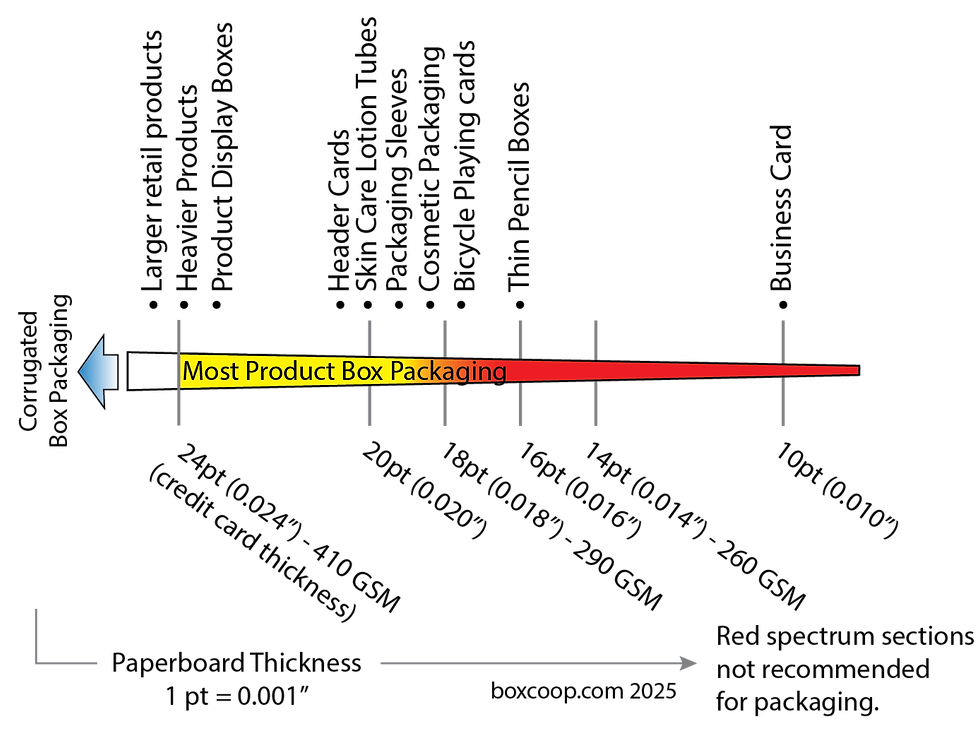
Paperboard Thickness Chart
.png)
What's a Good Paper Thickness for My Box?
-
16pt (0.016″ ≈ slightly thicker than a business card)
-
Best for very small product boxes.
-
Rule of thumb: footprint (floor of the box) of about 1″ × 1″ or smaller.
-
-
18pt (0.018″ ≈ just under credit-card thickness)
-
Strong enough for most cosmetics, food, and shelf packaging.
-
Cost-effective and versatile — the “everyday” choice for custom boxes.
-
Rule of thumb: footprint of about 2.75″ × 2.75″ or smaller.
-
-
24pt (0.024″ ≈ credit-card thickness)
-
Stiffer and more rigid, with a premium feel in hand.
-
Ideal for larger, heavier, or higher-end products where strength and presentation matter.
-
Rule of thumb: footprint of about 3″ × 3″ or larger.
-
Cardstock.... or Paperboard?
The paper behind your packaging matters
You may have seen box specs like “18pt cardstock” online — but not all 18pt paper is created equal.
• Cardstock: A thick paper used for crafts, postcards, and invitations. It’s cheaper and technically works for light packaging — but it lacks the stiffness and durability needed for most product boxes.
• Paperboard: A stiffer material engineered specifically for packaging. It folds cleanly, glues reliably, and holds its shape to protect your product — and your brand — on the shelf.
The key is knowing what you’re buying. In retail, your product box is what closes the sale — so it needs to perform and look its best. That’s why we use a quality paperboard — so your packaging doesn’t just hold together, it helps sell what’s inside.
3 Big Reasons Tuck End Boxes Are So Widely Used
Used for so many everyday retail products
Easy to customize
An economical folding carton style
And What About Secondary Packaging?
Custom printed tuck end boxes are also widely used as secondary packaging. They’re an easy way to turn ordinary tubes, bottles, jars, and towelettes into branded retail packaging that stands out on the shelf.
This is especially common in cosmetics, skincare, and private label packaging, where presentation plays a big role in buying decisions.

Custom Options
From easy-open thumb tabs to built-in partitions, tuck end packaging offers practical options that make your cartons work harder.
Straight tuck end (STE) or reverse tuck end (RTE) closure styles
Hang tabs for peg display
Half-moon thumb tabs for easier opening and re-closing
Friction or slit locks on tuck panels
Postal locks for extra security
Inside partitions or custom inserts for multi-item packaging
Explore tuck end folding carton options, closures, and custom inserts →
Frequently Asked Questions About Tuck End Boxes
What’s the difference between straight tuck and reverse tuck end boxes?
A reverse tuck end (RTE) box has top and bottom flaps that close in opposite directions. A straight tuck end (STE) box has both flaps closing toward the back, which keeps the front panel cleaner for graphics and shelf presentation.
Can tuck end boxes be used as hanging retail packaging?
Yes. Tuck end cartons can include die-cut hang tabs or hanger holes so they can hang on peg hooks or display racks. This turns a standard folding carton into hanging retail packaging for lightweight products like cosmetics, accessories, and small electronics.
What’s the difference between straight tuck and reverse tuck end boxes?
A reverse tuck end (RTE) box has top and bottom flaps that close in opposite directions. A straight tuck end (STE) box has both flaps closing toward the back, which keeps the front panel cleaner for graphics and shelf presentation.
Can tuck end boxes be used as secondary packaging?
Yes. Tuck end cartons are commonly used as printed secondary packaging for products already sealed in another package—especially squeeze tubes for lip gloss, creams, lotions, and skincare, as well as bottles, jars, or pouches. The tube is the primary package, while the folding carton adds branding, product information, and retail shelf presence—common in cosmetic tube packaging.
Can tuck end boxes be used for e-commerce shipping?
Tuck end boxes are mainly designed for retail shelves, not direct shipping. Many brands place the tuck end carton inside a sturdier mailer box or shipping carton for e-commerce fulfillment.
Get Started on Your Custom Tuck Box
Tell us about your product dimensions, branding needs and finish and we’ll recommend the right tuck box for you.
Work with Folding Carton Experts
At The Box Co-op we don’t just offer tuck boxes—we are tuck box specialists. Every box we make is a custom paperboard folding carton, built for quality, consistency and impact.